

Gaming Market Growing from USD 281.77 Billion in 2023 to USD 665.77 Billion by 2030 at 13.1% CAGR
Gaming Market Share
The global gaming market was valued at USD 249.55 billion in 2022 and is projected to grow from USD 281.77 billion in 2023 to USD 665.77 billion by 2030.
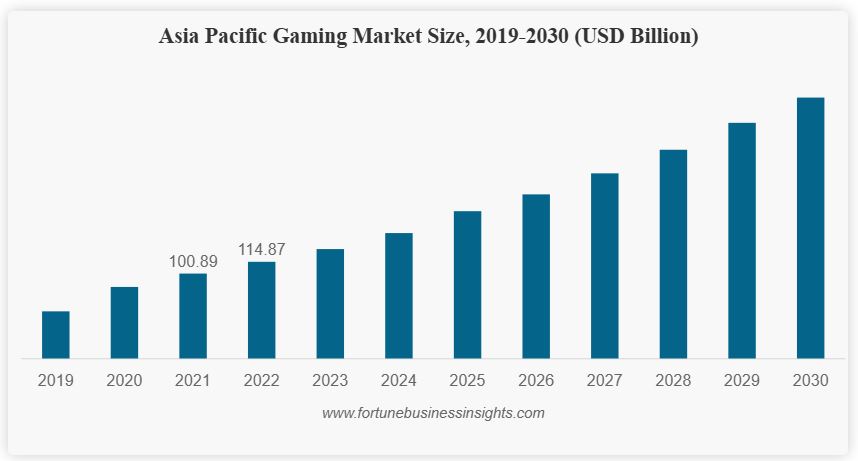
PUNE, INDIA, February 9, 2026 /EINPresswire.com/ -- The global gaming market was valued at USD 249.55 billion in 2022 and is projected to grow from USD 281.77 billion in 2023 to USD 665.77 billion by 2030, exhibiting a CAGR of 13.1% during the forecast period. Asia Pacific dominated the gaming market with a share of 46.03% in 2022, supported by rapid urbanization, high smartphone penetration, and strong consumer spending on home entertainment.Market growth is primarily driven by the increasing inclination of youth toward gaming, rising popularity of mobile and online multiplayer games, expanding esports ecosystem, and continuous technological advancements in graphics, augmented reality (AR), virtual reality (VR), and cloud gaming.
Gaming has evolved beyond traditional entertainment into a mainstream digital lifestyle activity, offering stress relief, social connectivity, and immersive experiences. The increasing affordability of smartphones, widespread 4G/5G connectivity, and growing availability of free-to-play and subscription-based gaming models are further strengthening global adoption across diverse age groups.
Get Free Sample Research Report:
https://www.fortunebusinessinsights.com/enquiry/request-sample-pdf/gaming-market-105730
Top Companies in Gaming Market
• Microsoft Corporation
• Sony Group Corporation
• Nintendo Co., Ltd.
• Tencent Holdings Ltd.
• Activision Blizzard, Inc.
• Electronic Arts Inc.
• NVIDIA Corporation
• Valve Corporation
Gaming Market Trends
One of the most prominent trends shaping the gaming market is the growing popularity of esports tournaments and online gaming championships. Competitive titles such as shooter and multiplayer online battle arena (MOBA) games attract millions of viewers globally, driving in-game purchases, sponsorships, and advertising revenues. The increasing prize pools and professionalization of esports are motivating more players to participate competitively.
Another key trend is the rising adoption of cloud gaming platforms, which allow users to stream high-quality games without requiring expensive hardware. This is lowering entry barriers and expanding the potential user base. In addition, the integration of AR and VR technologies is enhancing immersion, enabling players to experience more realistic environments and interactions.
Mobile gaming continues to gain momentum as developers increasingly prioritize mobile-first game design. Social and casual games with microtransaction-based monetization models are becoming especially popular among new and non-traditional gamers.
Gaming Market Growth Factors
The increasing inclination of youth toward gaming is a major driver of market growth. Video games are increasingly used as a primary source of entertainment and social engagement. Many parents also recognize educational and cognitive benefits associated with gaming, further supporting adoption among children.
The rapid rise in smartphone usage and affordable internet access has significantly expanded the mobile gaming audience. Mobile devices now account for a large share of total gaming revenue, supported by app store ecosystems and frequent content updates.
Rising spending on home entertainment systems, including gaming consoles, high-performance PCs, and accessories, is another important growth factor.
Additionally, growing investments by major publishers in new game development, live-service models, and cross-platform compatibility are helping sustain long-term engagement.
However, concerns regarding gaming addiction and its potential impact on mental health, particularly among children, may restrain market growth. Increasing awareness about screen-time management and parental controls is influencing purchasing behavior in certain demographics.
Gaming Market Segmentation Analysis
The gaming market is segmented by game type, device type, and end-user.
By game type, the market is categorized into shooter, action, sports, role-playing, and others. The shooter segment is expected to retain the largest share due to its realistic 3D graphics, tactical missions, competitive multiplayer modes, and frequent content updates. Role-playing and action games are also experiencing strong growth, driven by immersive storytelling and open-world gameplay.
By device type, the market includes PC/MMO, tablet, mobile phone, and TV/console. Mobile phones are anticipated to hold the dominant share, supported by widespread smartphone adoption and developers’ strong focus on mobile game launches. PC/MMO and console gaming remain popular among core gamers who prefer high-definition graphics and performance-intensive titles.
By end-user, the market is divided into male and female. The male segment currently accounts for a larger share, owing to higher participation in action, shooter, and sports games. However, the female segment is expected to grow steadily, driven by the increasing popularity of casual, social, and mobile games and the influence of streaming platforms.
Speak to Analyst:
https://www.fortunebusinessinsights.com/enquiry/speak-to-analyst/gaming-market-105730
Regional Insights
Asia Pacific leads the global gaming market, driven by strong demand from China, Japan, South Korea, and Southeast Asian countries. High smartphone penetration, large youth population, and strong esports culture are key growth contributors.
North America represents a mature but steadily expanding market, supported by high adoption of consoles, PC gaming, and cloud gaming services. The U.S. remains a major contributor, with a large base of gamers across all age groups.
Europe is witnessing substantial growth due to increasing investments in esports infrastructure and supportive government initiatives for the gaming industry, particularly in countries such as Germany, France, and the U.K.
South America is experiencing rising adoption of online and mobile games, supported by growing internet penetration and affordable smartphones, especially in Brazil.
The Middle East & Africa region is expected to register notable growth, driven by increasing smartphone usage and improving digital infrastructure, particularly in Sub-Saharan Africa.
Key Industry Developments
• July 2022: Sony invested USD 3.6 billion to acquire Bungie, Inc., strengthening its game development portfolio.
• January 2022: Microsoft announced a USD 68.7 billion acquisition of Activision Blizzard to expand its gaming and cloud ecosystem.
• May 2022: Take-Two Interactive acquired Zynga for USD 12.7 billion to strengthen its presence in mobile gaming.
• November 2020: Microsoft launched next-generation Xbox Series X and Series S consoles.
Related Reports
Esports Market Size, Share & Industry Analysis
Cloud Gaming Market Size, Share & Industry Analysis
Ashwin Arora
Fortune Business Insights™ Pvt. Ltd.
+1 833-909-2966
sales@fortunebusinessinsights.com
Visit us on social media:
LinkedIn
Facebook
X
Legal Disclaimer:
EIN Presswire provides this news content "as is" without warranty of any kind. We do not accept any responsibility or liability for the accuracy, content, images, videos, licenses, completeness, legality, or reliability of the information contained in this article. If you have any complaints or copyright issues related to this article, kindly contact the author above.
